How to turn historical research into a compelling story
Historical novelists usually start with a love of history, maybe a specific period or a fascinating individual. But this can also be our downfall. It is tempting to share all the detailed research we have uncovered. But readers of fiction are not interested in the nerdy historical details. They want to be swept away by the characters and plot. Yes, the setting must be authentic and atmospheric, but it needs a light touch.
So how do authors strike the balance between a faithful and accurate representation of the era and a compelling story? Here’s what I have learnt on my own journey. While I don’t pretend to be an expert, I hope my dilemmas will illustrate the lessons I have learned.
1. Start with characters and their motivations
Who are the main protagonists in your story? Who faces problems and must make choices? Who will readers identify with? It might be the ordinary people who take a risk rather than those in positions of power.
Writers must resist the temptation to plan too broad a scope and encompass dozens of people. Readers find it harder to connect with multiple characters. If you can find letters, photographs and contemporary accounts from your chosen era and setting, that helps you identify with your characters, understand the world they lived in and why they made their choices.
Writing about the copper boom of 19th century Swansea I focused on a master mariner who sailed round Cape Horn to Chile to bring back copper ore for smelting. I wondered why he gambled on such a dangerous voyage, when he came from a poor rural family? And why did his wife choose to marry a sailor, knowing he would be away at sea much of the year? It also helped that this couple were my great-great grandparents, so I was awash with background material.
2. Decide where to start - and finish
Your historical research may well have concentrated on all the events leading up to your characters’ significant choices. But a novelist has to select the frame they work within, rather like an artist using a cardboard cut-out to select their composition.
What incident prompts your main characters to action? That is your starting point - you can fill in the backstory as you write. And is there a point in time when the main character’s problem or conflict is resolved? That’s your end point. You can refer to what happened next in your historical note.
In my novel, Copperopolis, for John, I started when he ran away to sea, and for Margaret, when she met him, a few years later, when he was a sailor. I finished when at last they were able to sail together.
3. Map out the turning points and key scenes
Use your historical research and what you know about your protagonists’ goals and obstacles, to map out the turning points in the novel - the reversals when events intervene, and plans are forced to change. If these connect to external historical events, you must respect the actual dates as far as possible. But for internal dilemmas, you have more of a free hand.
This is where you can use classical story frameworks such as the three act structure to build a shape for your novel that has rising stakes and conflict. I found Into the Woods by John Yorke a useful reference book here, as it covers many different story structures. It does take some work to decide how your chosen slice of history can map onto this structure, but that’s all part of the challenge of writing historical fiction.
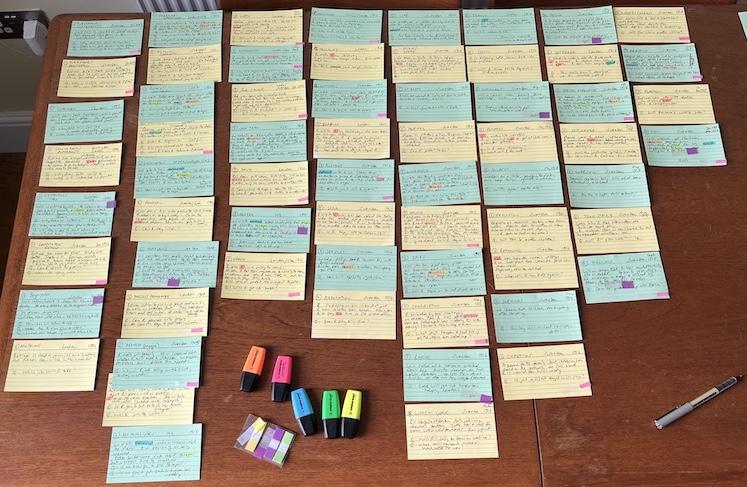
I use coloured index cards to note down promising ideas for scenes and turning points and then add the date where they referred to known historical events. This exercise might prompt you to revise where your story begins and ends, so your most dramatic incidents fall at the climax of the story.
4. Plan points of view
Debut authors are usually advised to limit the number of points of view to two or at most three. Readers need time to acquaint themselves with each character, so if you have four or more characters it is harder to build those connections.
Who in your story must make the most momentous choices and face the consequences? Who changes the most during the story? They are your protagonists. For each scene you have noted on your index cards, who is taking action or is most affected by what happens? That person should be narrating that scene.
In Copperopolis, John narrates scenes set at sea or when deciding on a voyage, or dealing with its aftermath. Margaret narrates scenes where she is discovering the local impact of the copper trade. Scenes of conflict between the couple are narrated by the one who feels it more strongly. I found it useful to write a scene from both perspectives before deciding which one to select.
5. Use flashbacks and backstory to explain context
Historical novels often span a decade or two. And novelists are keen to show cause and effect, and the impact of the era on the choices available to a character and the consequences. But not every event has to be shown in real time. Keep the most dramatic turning points in “immediate scene” but you can use flashbacks or backstory to refer to childhood events or previous decisions. Internal monologue or dialogue are useful methods to drip this in to the narrative.
When editing Copperopolis, I deleted some of the less dramatic scenes, involving secondary characters, and instead incorporated a summary of prior events into the reflections of main characters.
6. Decide what real-life incidents to leave out
Real life is messier and more meandering than fiction. If you are basing your novel on a real person, it can be tempting to follow exactly the course of their life. But this risks losing the attention of your reader. In the world of a novel, action and consequence are far tidier. So you may need to excise some diversions and digressions in your character’s story.
In my research for Copperopolis, I had a full list of all the ships John skippered. But for the novel, I focused on one ship that was wrecked in the Atlantic, and the ship he skippered around Cape Horn. Although in reality Margaret accompanied him on multiple trips, I only described two in the novel, her first and her last.
7. Focus on conflict, stakes, action and consequences
“There are decades when nothing happens and weeks when decades happen.” (a quote often attributed to Lenin)
If your novel spans multiple years, you need to select the most significant conflicts and actions and cover these in detail, while skipping over the intervening, less consequential, years.
Dividing your novel into parts or sections can help here. Readers can understand that time might pass as they turn a blank page, especially if you clearly label the year or any change of location. Switching point of view for a new chapter can also help with time jumps. Consider including a line or two that refers to the intervening time - maybe the passage of seasons or an external event, or even a progression of internal thoughts - to orientate the reader.
As I edited Copperopolis, I started a new part when there was a significant time jump. And when I had a gap of a year or more between chapters I aimed to connect them with an internal thought on the same theme. Plus I labelled the date in the chapter heading.
8. Accept this is an iterative process
Writing a novel is a messy business. You may decide on your setting, time frame, characters and story structure, then start writing only to discover that another character or set of incidents would be more compelling. Once a draft is written, you may need to map out the key scenes again on index cards, and revise what to include or delete. Reassure yourself with the thought that nothing you have written is ever wasted - keep it in a folder as it may help inform backstory in future drafts. If you seek external professional editorial input, this may result in structural change, or excising information dumps or peripheral characters.
I started writing Copperopolis seven years ago. I have received feedback from professional editors and most of the scenes have been workshopped with fellow writers. I have burned through stacks of coloured index cards and have dozens of earlier drafts in folders on my laptop.
The final version now with my publisher has very few words in common with my first draft. But after each round of edits and rewrites it emerged stronger and more polished. I have learned to embrace the process, and welcome external input while holding fast to my conviction about my story and characters.
About me
Copperopolis will be published in August 2026 - read more here.
If you are a historical novelist, I’d love to hear your experiences in converting your research into a compelling story. (see the contact page)
And if you are interested in hearing more about my journey to publication with Copperopolis, join my book club for regular updates and an exclusive copy of Chapter 2 of Copperopolis. You can read Chapter 1 here.