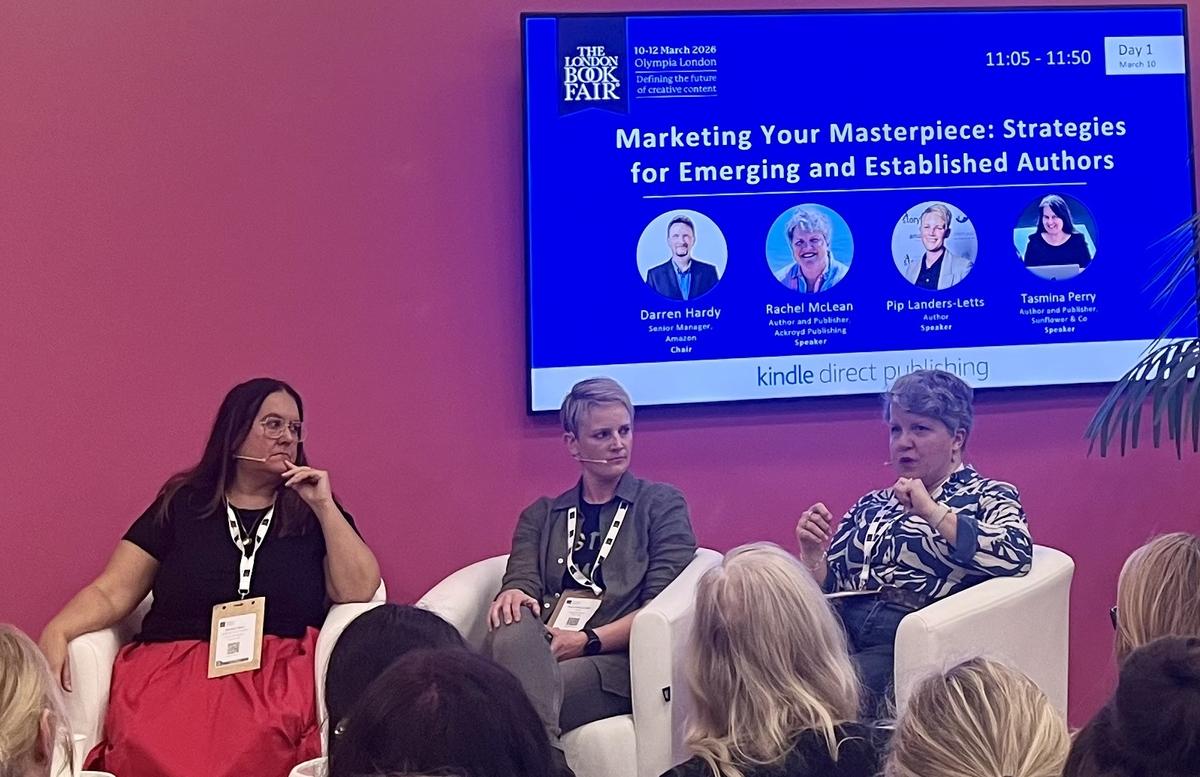
Effective marketing for authors: tips from London Book Fair
What are the most effective marketing activities for authors, whether traditionally published or self-published? How can authors promote their books without detracting from their actual writing?
Plenty of expert tips were shared by publishing executives and authors alike at the Author HQ at the London Book Fair 2026. This is my summary.
Building an author brand
Your author brand is not about your appearance, or even just the genre you write in. Amanda Harris had a much better definition – your author brand is how you make your readers feel, the emotions you stir in them. This is more specific than just the genre of your latest book and might make it possible to move between genres.
Content about your writing process – the locations, the research, developing plot and character – is far more relevant to readers than your personal life.
Remember, there are no overnight successes – this is a slow burn process. Allocate a specific amount of time - say an hour a day – for marketing and social media content, to protect your writing time.
Being a business partner with your publisher
If you are traditionally published, be a good partner. Meet deadlines and be easy to work with. Design your social media activity to complement what your publisher does – more of the behind the scenes and writing process. Hennah Sandhu advised against comparing your marketing campaign with that of other books and authors – their audience may be completely different.
Engaging with readers
While publisher marketing may be largely broadcast, authors can engage in direct communication with readers. Many authors pick one channel to focus on which matches their audience and where they enjoy creating content:
Rachel McLean , a crime writer, is not on social media, but instead sends her readers weekly newsletter, which includes behind the scenes info on the locations where her novels are based and her own writing process. Rachel also uses Facebook as that is where her readers are, but it is now less effective for organic reach.
Pip Landers-Letts, who writes contemporary sapphic fiction, focusses on Instagram. She started by observing what was working for other authors and has experimented with content to see what drives engagement. She has now also started a newsletter.
Tasmina Perry, who writes escapist commercial fiction, uses Substack, which has its own ecosystem.
Having your own website, however simple, provides a digital presence you own as opposed to building an audience on social media.
All agreed that building up a small group of “superfans” or “cheerleaders” helps with launching new books – you can offer them a signed copy in return for promotion – or an ARC in return for a review.
Reader quotes from reviews can be as helpful as famous author blurbs and you can feature on your website.
Include a preview of your next book in your digital edition with a link to pre-order.
Pip proactively asks to be on podcasts or speak at events and festivals – an opportunity to connect directly with readers.
Libraro is a new platform where writers can share unpublished extracts and get direct feedback from readers. Agents and publishers lurk to spot new talent.
Managing social media
Select the right platform for your book and its readers, and your appetite to create content. Be aware that content creation is a specific skill, different to writing.
Booktok is great for romantasy and YA and helps with discovery. Content here can be more authentic and less polished. Instagram is now the mainstream platform for authors – and is more curated and pristine. Twitter/X is no longer relevant. Bluesky is niche but has a “Booksky” community.
Video helps communicate both the author and the story/characters of your books and encourages people to talk about a book.
Know your boundaries – share only what you want to on social media. Content can be more about what you have learned, how you write, not your location or personal life.
Note that Instagram followers don’t directly translate into book buyers. Better to see social media as a way to direct people to your “owned” platforms such as website or email. Best-selling author Emma Gannon has now left social media (she has delegated her Instagram to others) and focusses on Substack. Long form content suits her better, and she can monetise her audience directly. But note, she has spent ten years building up a newsletter audience.
Alternatives to traditional publishing
Self-publishing authors, also known as “authorpreneurs” can earn a living through writing, which is rare for trad-published authors. A survey by ALLI (Alliance of Independent authors) showed that among those who spend at least half their time on self-publishing, median earnings are $80kpa, compared to c$10kpa for a trad-published author. However, successful indie authors have a back catalogue of typically 10-20 titles, so it takes time to achieve this level of income.
Top genres for self-publishing are romance, sci-fi, thrillers and mysteries. Many authors also make money from teaching or consulting.
It is crucial to build an email list to forge a direct relationship with readers, and their feedback informs future books.
Self-publishing means the author owns the risk and reward, and can connect directly with readers. There may be an upfront investment in marketing and production, but authors keep 40-60% of cover price so it can pay back quickly.
Self-published authors need to start marketing well in advance. Retail has always relied on keywords, but with growth in GEO (optimisation for AI) the trade can look at themes and tropes in the entire book.
Trad publishers are now watching self-published authors in order to spot new talent. Meanwhile companies that support self-published authors – such as Ingram Spark – are exploring how to retain their authors and not lose them! So the whole market is much more fluid, with some authors using both approaches.
How to build an effective author marketing campaign
So what does all this mean for authors? Here’s the top tips
- Define your author brand
- Have a (simple) author website
- Be a good partner to your publisher (if you have one)
- Pick a way to engage with readers (e.g. newsletter, events) for long term feedback
- Choose the social media platforms you are comfortable with
- Share content about your writing not your lifestyle
- Accept it’s a slow burn
- Set aside specific time for marketing – the writing should come first
- Consider whether self-publishing might work for you.
If you have practical tips on author marketing, please share via the contact page on this website.