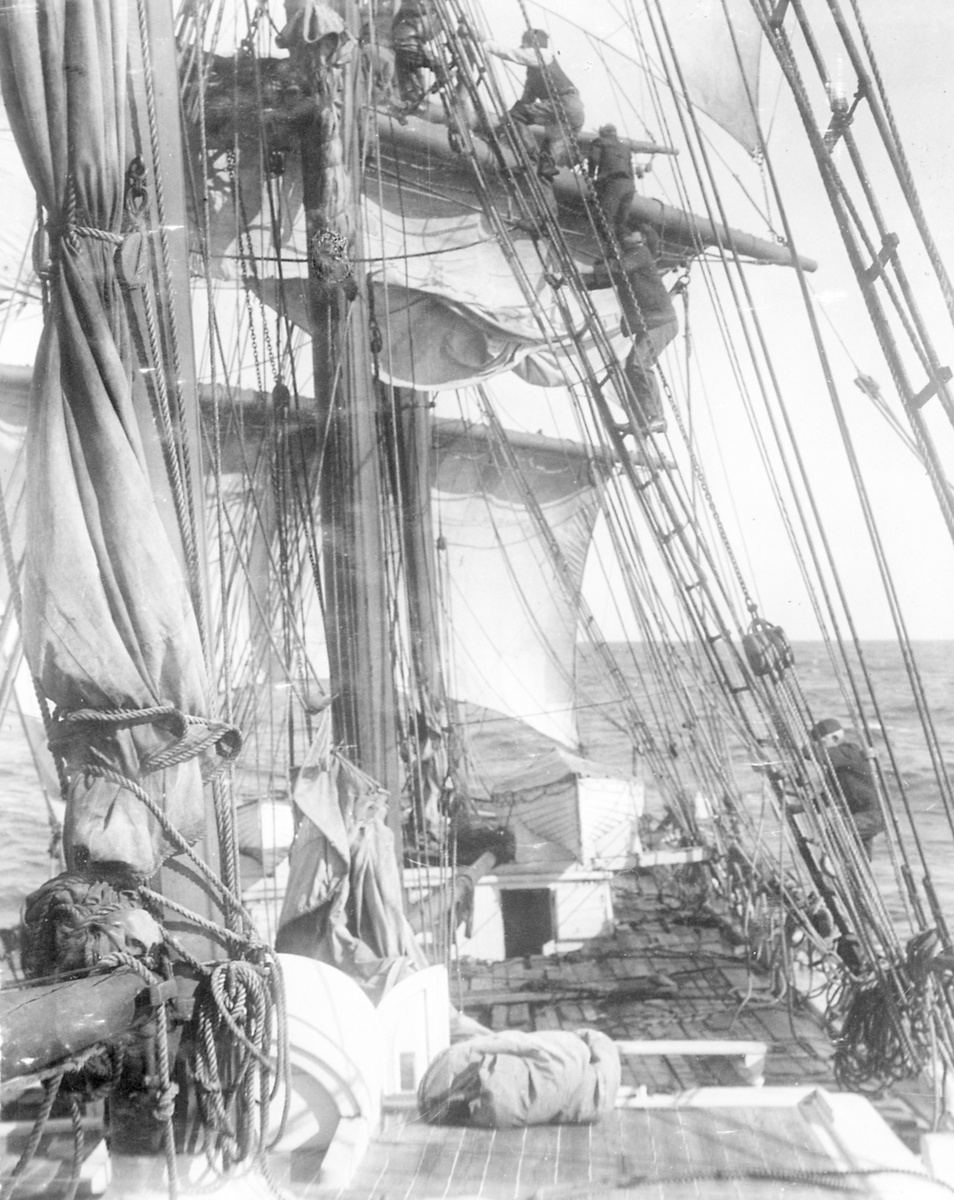
Career of a master mariner in 19th century
How could a poor rural boy build a career as a master mariner? And what was the job like in the second half of the nineteenth century?
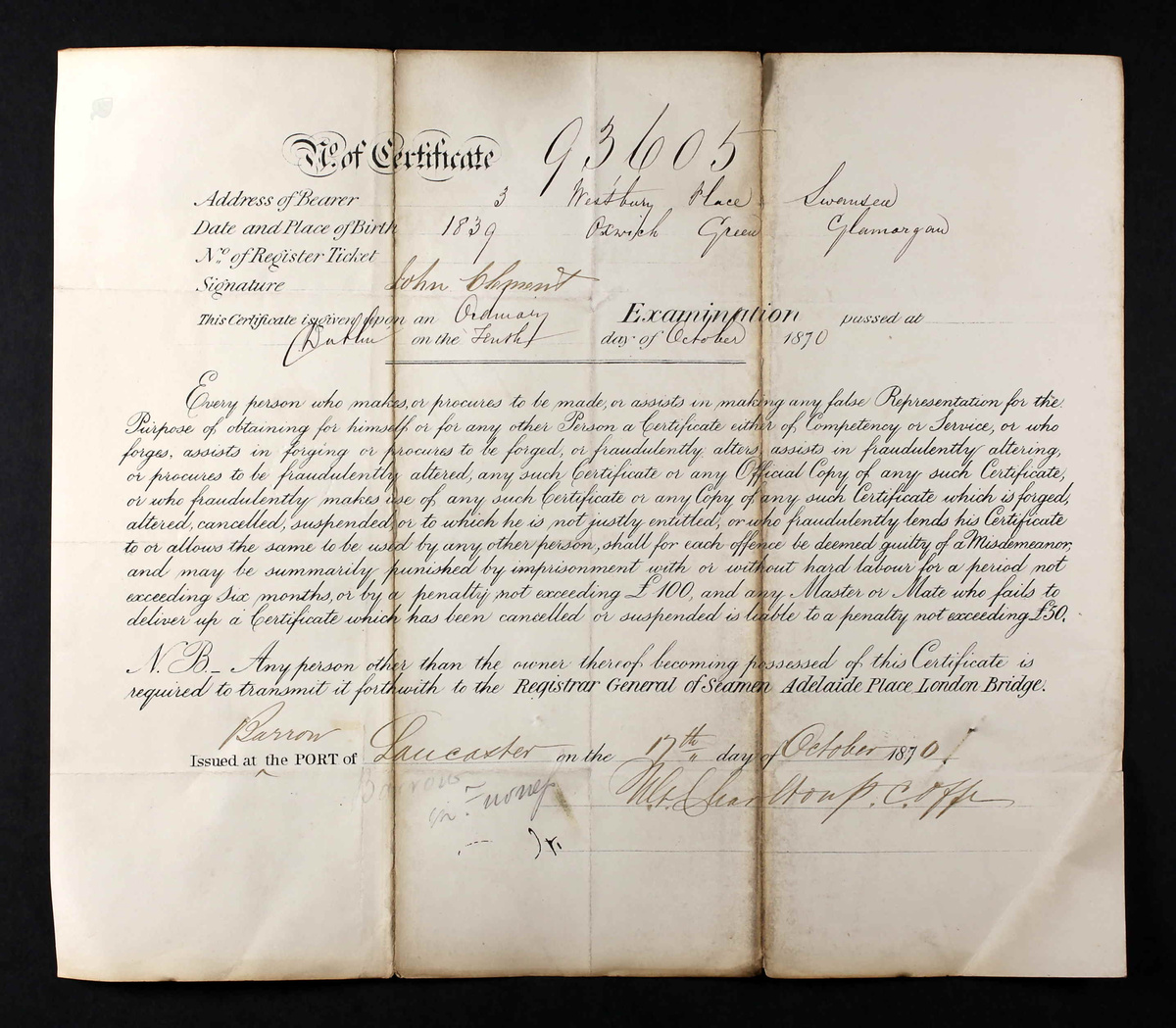
My great-great-grandfather, John Clement, was born in 1839 and became a master mariner in 1870 at the age of 31.
The route to becoming a master mariner
Coming from a family of farm labourers in rural Gower, he could not follow the route of apprenticeship, which was favoured by more wealthy families. The premium for an apprenticeship was £40-50 (about £5-6000 in today’s money) and out of reach for a family of nine boys where an adult farm labourer might be paid two shillings and sixpence a day (£15 a day in today’s money).
Sailing apprentices started at 13 or 14 and in theory received on-board training for four years, at the end of which they could take a role as second mate and lead a watch.
Those who could not afford an apprenticeship joined as ordinary seamen, as young as 13 or 14. This was the route John Clement took. Once he had learned to hoist, reef, trim and drop sails, and tie a range of knots, he could acquire the status of Able seaman, following a shipboard exam by the mate, boatswain and able seamen, with a certificate signed by the Master. Pay for able seamen in 1850 was £2 10 shillings a month (£300 in today’s money).
A Second Mate would be in charge of a watch and be paid £3 and 10 shillings a month. A First Mate would have to have at least 5 years sailing experience and would effectively be the second in command on board ship. Pay was up to £5 a month in 1862 (£550 in today’s money).
Reaching these levels of responsibility was in the gift of the Masters on a sailor’s voyages and required both hard graft and an ability to learn from experience. Sailors on the Swansea merchant trade in the Channel and Atlantic could be on a voyage for months and hailed from all over Europe and even the Americas.
The Merchant Shipping Acts in the 1850s required prospective Masters to take an exam in navigation, seamanship, rigging and maintenance. One Welsh woman, Sarah Jane Rees, daughter of a shipowner, ran lessons for aspiring Masters, showing that it was not unknown for women to learn to navigate. John Clement took his exam and gained his master’s “ticket” in 1870.
The role of a Master
The Master commanded the vessel and crew and also safeguarded the commercial interests of the shipowner. Pay varied but could be £10-20 a month (£1000-2000 in today’s money).
Swansea had 25-30 shipowners at the time, with between two and twenty merchant ships each. Ships were divided into 64 shares, and local merchants and widows might invest in shares. Shipowners (or a committee of shareholders) would appoint the Master, so a reputation could be built up in the shipping community over time for seamanship and commercial success.
The Master was responsible to the shipowner and hired the crew on his behalf. A merchant ship might have fifteen or twenty crew, mostly ordinary seamen or able seamen. As well as a First Mate and Second Mate, there would be a carpenter, a cook, and a boatswain, who would be in charge of rigging and maintenance.
Masters managed provisions. For a long ocean journey this required complex planning, laying in stores of salt meat, oats, flour, sugar, dried peas, sugar and sometimes live chickens or goats. Providing lime juice on long ocean passages to avoid scurvy was mandatory. Masters also held a basic medical kit, including chloroform, friars balsam, ipecacuacha and laudanum. Plus some rum in case surgery was required (usually performed by the carpenter).
Life at sea
The Master’s most important role was passage planning, taking account of ocean currents, prevailing winds and local weather conditions. At sea, he would determine the sail plan required to make good progress to a destination: which sails to hoist, reef, trim or drop, and the course to sail. Navigation was another responsibility, using a combination of charts, lights, landmarks, sextant, chronometer and stars to mark the ship’s position.
The crew slept in the forecastle in basic conditions, amid the mud and weed from the anchor chain. Masters and mates had aft cabins, and the cook and carpenter slept in the cookhouse, a shed on the middle deck.
The day was divided into watches: middle (midnight-4am), morning (4-8am), forenoon (8am-12pm), afternoon (12-4pm), first dog (4-6pm), second dog (6-8pm), first (8pm-12am). Crews slept when they were off watch: the Master did not keep a watch and could sleep when he had time or the weather was fair.
As well as negotiating on behalf of their owner for the main cargo, Masters could set aside some space in the hold for their own entrepreneurial trading. This enabled some Masters to earn enough capital to buy their own ship.
A Master had absolute power over the crew at sea. The First and Second Mate managed the watch system, but the Master was in charge of discipline, and could fine, imprison or even shoot a crew member. If he claimed there was a risk of mutiny, the courts back home would give him the benefit of the doubt.
Hazards of the role of Master
Hazards on board ship abounded. Cargoes of coal could combust in hot weather, and heavy cargoes (such as copper ore) could shift in rough seas. Crew could fall from the rigging or be washed overboard by powerful waves. South of Cape Horn lurked vast icebergs which could suddenly capsize and expose their underside, causing large waves. The strong tides and violent storms of the Bristol Channel wrecked many ships on their homeward journey. Sailors could pick up diseases in foreign ports (such as yellow fever) which then became evident on board ship.
If a ship was wrecked, a Master could face an investigation by the Board of Trade to identify whether he was at fault, or there was a failure in maintenance or loading. A Plimsoll line was mandatory from the 1870s to guard against unscrupulous owners and Master’s overloading cargoes. There were definitely incidents of deliberate scuttling, where an owner and Master conspired to lose a ship, then claim on insurance.
The story behind Copperopolis
My novel Copperopolis is based on the life of John Clement, master mariner and skipper on the copper trdae to Chile around Cape Horn.
Join my book club for reviews and recommendations on historical fiction and Swansea history
More about Swansea & Gower History
The copper boom in Swansea and Gower
Sailing a copper barque around Cape Horn
Profit and pollution in Swansea copper
Gower rural life in the 19th century
Women in 1800s Swansea and Gower
Useful links
The Swansea Copper barques and Cape Horners by Joanna Greenlaw