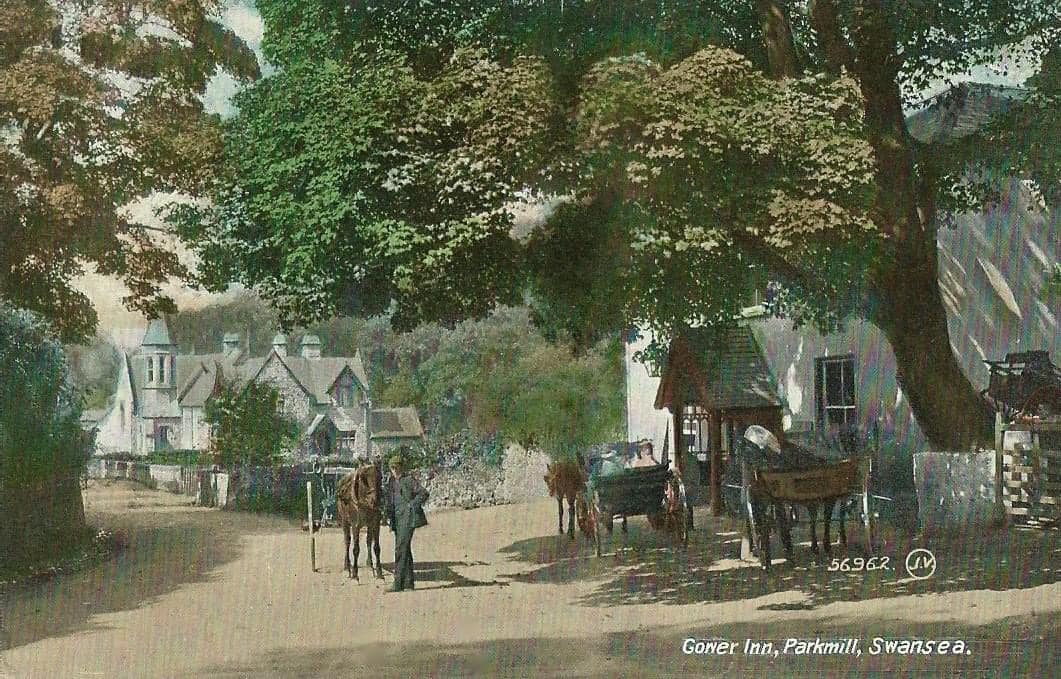
Gower rural life in the nineteenth century
Gower is a remote peninsula with diverse landscapes: lush cliff top farmland, shady woods, scrubby commons, salt marshes and perilous rocky coves interspersed with long sandy beaches. Isolated from the city and port of Swansea, its inhabitants have always lived off the land and the sea.
The weather is highly changeable – fierce storms and heavy rain in the winter, sea-mist in the spring and autumn, but short periods of intense sunshine in the summer. And life is dictated by the extreme tidal range, with up to 13 meters between high and low water turning wide sandy beaches into choppy, rocky bays within hours.
The early life of my great great grandparents
When researching my novel Copperopolis, I was interested in the environment my great-great grandparents, John Clement and Margaret Morris grew up in, before they moved to a seafaring life in Swansea.
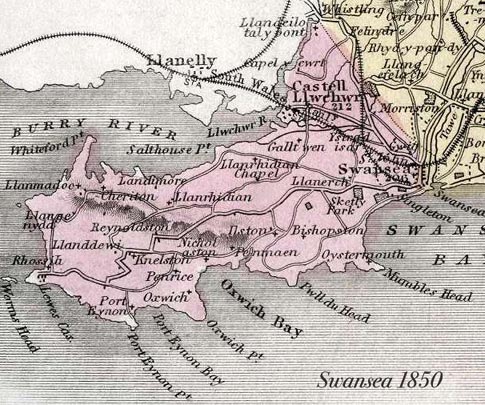
At the time of their early life, between 1840 and 1870, many people in Gower lived at a subsistence level. Large estates like Penrice hired dozens of labourers, and a network of family farms raised cattle and sheep, and grew vegetables. South Gower (Oxwich, Pennard, Penmaen) was English speaking, with strong links to North Devon, while North Gower (Penclawdd, Llanridian) was Welsh speaking. Margaret’s family farmed at North Hills, Penmaen (now a campsite) while John’s family lived in Oxwich Green, and were labourers on the Penrice estate. What was it like growing up there?
A history of smuggling and wrecking
During the late 18th century, brandy and wine were regularly smuggled into Gower coves from France, and tea, tobacco, salt and soap from Ireland. But by the 1850s Customs enforcement was too effective and smuggling too risky.
Rocky headlands along the coast meant many ships came to grief. By the time the authorities were aware of a shipwreck, it had usually been stripped. Cargoes included oranges, lemons, and timber. Few Gower inhabitants actively tried to wreck ships by false lights. However, they believed that scavenging for goods along the shoreline fell under a “finders keepers” rule.
Lime trade built links with Devon
Limestone rock was quarried and burned in small lime kilns along the coast. Lime was used to paint buildings to protect them from damp and was mixed in with the soil as fertiliser. Lime from Gower was in demand from North Devon farmers and the easiest way to transport it was in small boats across the Bristol Channel. By the 1880s the lime trade was in decline, and it had ended by 1900. But lime kilns remain around Gower.
Farming the main activity
Saleable crops included wheat, barley, beef, mutton, eggs, poultry and pigs. People would keep their own pigs and grow potatoes, cabbages and swede. Produce was dragged up steep hillsides on wooden “slide cars” to be loaded onto carts for market. Horses were used for all farm work.
The larger farms employed many labourers. Some would live on the farm and were paid £5 per year (£600 in today’s money). Daily labourers might be paid 2 shillings and sixpence a day (about £15 in today’s money). Women and children were paid less.
The main Gower farming families would organise for their daughters to marry into other large farming families, to keep the land in the extended family. There was a clear social divide between those who owned and farmed their own land and the labourers.
Getting around
People would walk long distances. Livestock was driven along the road to Gowerton market. You could catch a dray horse from the main Bishopston road into Swansea market. Or walk to Mumbles to catch the train into Swansea town.
Basic housing
Homes had thick stone walls, and small windows, so were often dark inside. People gathered around the fire to keep warm in the cold, wet winters. Lighting was by candles, and later oil lamps. A separate privy or “Ty Bach” was at the back of the house.
A brief childhood with limited schooling
In 1870 school attendance became compulsory. However rural children might disappear from school for harvest or planting. Some widows set up small private schools in their homes. In 1850 the school in Bishopston was taken over by the church. But the leaving age was just eleven in 1893 and was only raised to twelve in 1899. A small number of children continued to study after leaving school.
Girls of 12 or 13 were engaged as domestic servants, as were some boys. Apprenticeships in skills like weaving, blacksmiths, lime burning, wheelwrights or malting tended to stay in families.
Domestic life for women
Rural women had a hard life. They might load lime onto ships, keep pigs and chickens and grow their own vegetables or do casual farm work. As well as baking bread and cooking for the extended family some brewed their own beer. Farmer’s wives might be expected to feed all the labourers living on-site as well as their own family.
Families were large, six or even ten, and many children died. There was an outbreak of scarlet fever in 1880 and typhoid in 1885. When babies died the next child often took the name of the dead baby.
A wish to escape
From Gower’s grassy or wooded cliff-tops, an endless parade of ships were visible, traversing the Bristol Channel, ferrying goods to and from Cornwall, France or further afield. No wonder this ignited John Clement’s urge to go to sea and explore the world. And I can imagine the frustration felt by Margaret Morris, fearing a life of being trapped in a farm kitchen, watching sailors passing the waters of Three Cliffs Bay.
Join my book club for reviews and recommendations on historical fiction and Swansea history
More about Swansea & Gower History
The copper boom in Swansea and Gower
Sailing a copper barque around Cape Horn
Profit and pollution in Swansea copper
Women in 1800s Swansea and Gower
Useful links