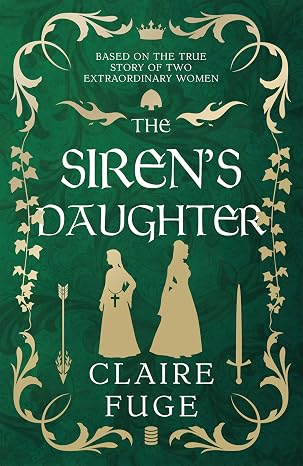
Book review: The Sirens Daughter by Claire Fuge
The Sirens Daughter by Claire Fuge
What a captive Welsh princess has to do to survive Norman occupation - as told to her daughter.
Story
Wales, 1126. Angharad is the daughter of a captive Welsh princess and a Norman knight. When her mother, Nesta, is obliged to marry Etienne, commander of a Norman castle, Angharad must follow her, and submit to an arranged marriage with an older Norman.
Angharad’s new stepfather insists she spy on her mother who he suspects of secretly plotting with the rebellious Welsh. As Nesta recounts her life of betrayal, scheming and deliberate seduction, Angharad realises how easily her mother has deceived her, and questions her own beliefs. When the risk of Welsh rebellion grows, Angharad must decide whether to protect her mother or herself.
Setting
Norman occupied Britain was a brutal place. The French invaders bolstered their rule with domineering cruelty towards the English and Welsh peasantry. This novel depicts not only the draughty cold castles and gruesome battle wounds and ailments, but also the casual violence inflicted on slaves, so-called traitors and accused criminals, from castration and blinding to ordeals by water and burning at the stake. Christianity was contorted to provide divine legitimacy to any action taken by the King and his knights.
The author lingers on the daily life of a castle, from the brewing of ale and slaughter of livestock to the feasts, clothes, jewels and tapestries that softened the edges of a harsh life. With a constant sense of threat as riders emerged from the mist, bringing news of new alliances, battles and betrayals.
Characters
Angharad does not leave the castle and must rely on what she is told by her stepfather and her mother, or what she overhears. Brought up as a pious, god-fearing Norman, she resists her mother’s pride in their Welsh lineage. But as she learns more of Nesta’s colourful life, Angharad starts to question her own loyalties.
Nesta is a complicated woman, who has suffered hardship and treachery, learning how to deceive her many husbands and lovers, and protect her children while taking pride in her royal Welsh ancestry. Speaking Welsh, Latin, Norman and even English as needed, she deploys her beauty - and ruthless cunning - to achieve her ends.
The men in this story - Etienne, Henri Beauclerc, Henri Fitzroy, Wulfnoth – are more lightly sketched. I warmed most to Gruffudd, Nesta’s rebellious brother.
My opinion
This era of Welsh and Norman history is convoluted, with many alliances, betrayals, murders, attacks and retreats. The list of characters in the back of the book is helpful, but I could have done with a timeline, family trees and a map of the locations mentioned.
This complex backstory emerges in reported speech, as told by Nesta to Angharad in small portions as they go about their daily life in the castle. It loses a degree of drama and immediacy among all the quote marks, and I wonder if it might have been more vivid if shown as scenes from Nesta’s point of view.
But arguably the emotional heart of the novel is unravelling whether Nesta is telling truth or lies, so there is a logic to observing past events through Angharad’s somewhat naïve eyes.
I came away with three thoughts. One, realising how visceral and grim life was in the twelfth century, even in the protected world of the nobility. Two, how intensely the Welsh desired to rid themselves of the occupying Normans and their willingness to risk everything for that end. Three, how women caught up in this conflict learned how to charm and flatter, plot and scheme to protect themselves and their children.
Worth reading for an authentic insight into the struggles of this period of Welsh history, and a slice of the reality of life for women in a Norman castle.
Published by The Book Guild
Author website: https://clairefuge.com/
Enjoyed this review?
Join my book club for monthly updates on new reviews and a behind the scenes look at writing historical fiction