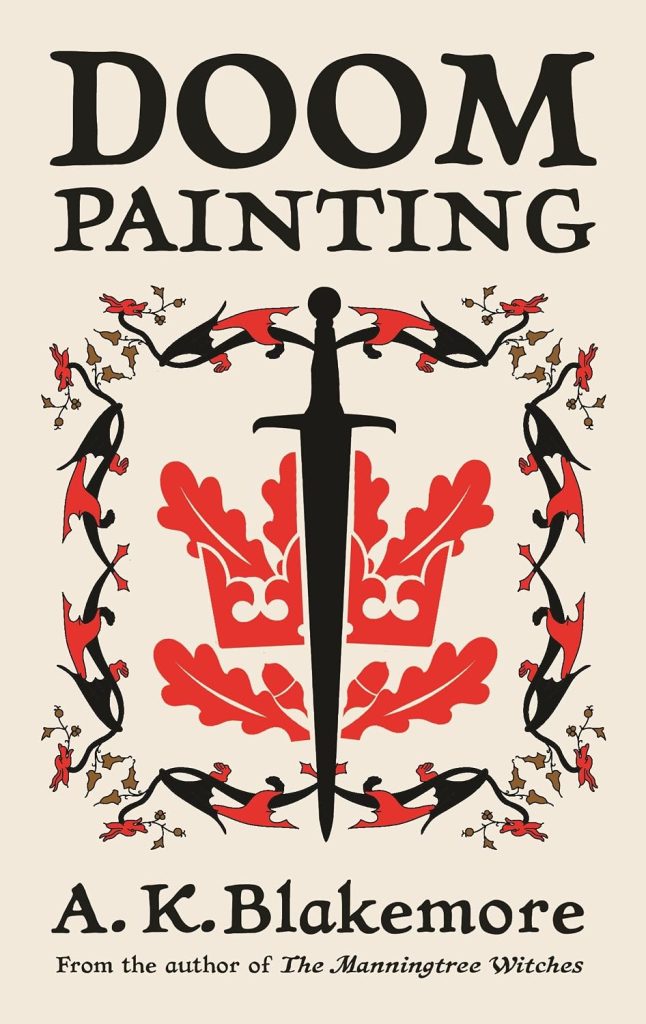
Book Review: Doom Painting by A.K.Blakemore
Sixteen days of the Peasants Revolt recounted in hourly scenes, as Wat Tyler leads the commons in Kent and London to a violent assault on the nobles of London.
Story
Essex 1381. The Lords of England are squeezing the peasantry with a poll tax to fund war with France. The “commons” rise up under reluctant leader Wat Tyler. Leaving a violent trail across Essex, they march on Rochester and Canterbury, and thence to London for a final, turbulent confrontation with boy-king Richard and his scheming nobles…
Setting
Blakemore was a poet before a novelist, and deploys virtuoso language to conjure the sights, sounds, smells and sensations of both the English countryside in that fateful June, and the grim trudge of peasant life, in contrast to the opulence of the nobles and Church.
Written in present tense and real time over sixteen days, each chapter is further divided into hours. The narrative swoops like a summer swallow between a motley cast of peasants, royalty and scheming middlemen across Essex, Kent and London.
The Revolt is organic, impulsive and chaotic, barely planned, and yet men and women of the oppressed Commons keep joining Wat Tyler’s rag tag army, until the landowner class can no longer ignore or suppress them.
Characters
Wat Tyler is the centre of the novel, with half the book from his point of view. A battle-hardened veteran of wars against France, he is impulsive and violent yet possesses both a deep sense of grievance at the exploitation of the Commons by the lordly class, and an aptitude for poetic rhetoric before a crowd. His unexpected status as a popular leader is both the making of him and his downfall.
Notable members of the Revolt include the renegade preacher John Ball, Tyler’s boyhood friend Jack Straw, market trader Thomas Baker, scheming Raven and courageous Johanna Ferrour (for women joined the rebels).
Boy-king Richard and his mother Joan are (almost) sympathetic, although selfish and cruel when advised by treacherous nobles, most of whom meet satisfyingly gruesome ends.
My Opinion
Doom Painting is of epic length and breathless, real-time pace, with its relentless round the clock action. I found myself updating my partner as if with dispatches from the battlefield. “They are besieging Rochester Castle” ….. “They are riding into Canterbury Cathedral.” The prose swings from lyrical descriptions of nature to earthy peasant banter to violent confrontation from one “hour” to the next.
Not so much a reading experience as an immersion in the scrappy filthy world of 14th century English peasantry, and the venal manoeuvrings of the nobles, who consider the “Commons” as they might do livestock.
And yet, amid the authentic medieval dialect and customs, some themes reverberate and feel contemporary. Entitlement of landowning classes; the imposition of a poll tax to fund grand projects; an elite who despise the commons, and are startled to find they are outnumbered and at a disadvantage when the masses rise. Lessons from the 1380s here for the French aristocracy, the Russian tsars and more recent unpopular autocrats.
Published by Granta
A version of this review appeared on the Historical Novel Society site Nov 2026.
Enjoyed this review?
Join my book club for monthly updates on new reviews and a behind the scenes look at writing historical fiction